Showing posts with label Special Collections. Show all posts

Sunday, 12 January 2014

Libraries@Cambridge conference 2014

I have been to four Libraries@Cambridge conferences now, and when I compare the conference to others I've been to (thinking about Umbrella and CILIP New Professionals Conference mainly) I think Libraries@Cambridge is as good or better in lots of ways. It's free, organised in a relatively short time frame by Cambridge librarians, with most of the speakers working in Cambridge libraries, so it's usually very relevant to me. I think it's great hearing from the newest graduate trainees alongside the Bodleian's Head of Assessment and the UL's Head of Innovation.


I thought that the keynote presentation by Frankie Wilson was particularly good. A few bits that resonated with me: 
  • It's easy to change rules but harder to change the underlying culture – conscious and unconscious behaviour, values and climate.
  • Every time someone asks at the enquiry desk ‘how do I do…?’ that is feedback, and there may be something you could make more intuitive.
  • Do you pay enough attention to feedback, and do you take action? It’s easy to fall into the trap of saying that first year undergraduates for example just needs to learn ‘how it works'.
  • Are all staff (from student shelvers up) empowered to share their ideas for innovations? I consider myself lucky that I've always felt that I could share my ideas, both at Newnham and Homerton. However Frankie's mention of student shelvers has prompted me to make sure that our shelving team know that they can make suggestions.
  • "If you do the same thing every time, you’ll get the same results every time." This sparked a conversation in the Twitter backchannel with Sarah Burton, Ned Potter and Jo Alcock. We came to the conclusions that if something already works okay it probably won’t get changed, but it could potentially be better. However just because something fails once doesn’t mean it wouldn’t work another time in different circumstances.
  • Different groups/types of users will have different needs, so watch out for unintended consequences of your changes – what's better for one type of user may be worse for another.

Ben Outhwaite
Liz and I both went to the parallel session on Special Collections thinking that there may be something we could apply to Homerton's special collections (the annuals and Alice in Wonderland collection in particular for me). This session was split into three mini presentations - Ben Outhwaite from the UL's Genizah Research Unit, Suzanne Paul from the Manuscripts Department at the UL, and Camillo Formigatti and Daniele Cuneo from the Sanskrit Project, also at the UL.

Both the Genizah project and the Sanskrit project involved academics working with library staff on special collections to catalogue and digitise. Ben Outhwaite said that as well as benefitting from the academics' expertise, having academics working on special collections has led to events, funding etc. which wouldn’t otherwise have been possible. I think our special collections at Homerton have scope for collaboration with academics, something to think about more in the future.


Suzanne Paul worked with Emma Dillon from King's College London to put on a programme for Emma's students – each student was given photographs of a fragment, they then learnt palaeography, notation and so on in class, and then at the end of the term they came to the UL to see their fragment, learn about how they were stored etc. and worked on a catalogue record for the item. While this was a lot of work to put on, it benefitted both the library and the students. 

After the lunch my second parallel session was 'Quality for Who?' by Paul-Jervis Heath. I had volunteered to live-blog this session for the conference blog, so you can read the whole thing there.

The project that Paul and his design team have been working on has been to study students and academics and come up with 'personas' or sets of motivations and behaviours which are present in everyone at different levels. For example these are the three student personas in brief (there is a lot more detail in this PDF)
  • David is at Cambridge in order to get a job at a top firm. He's kind of interested in his subject, but targets what he does in order to build a network and find a job later. He 'hacks' the system by dividing the reading lists with his friends, and they then swap notes on the books they have read. 
  • Mattias is here to enjoy the things that university has to offer. He wants to do well, but he wants to make friends and have fun. 
  • Katrina is reading every single book on her reading list and is really feeling the pressure. She isn't sure she's on the right track, and is working well into the night and all weekend.
Paul students like David are setting things up on their own such as Facebook groups to share notes on books. Would it help if librarians were to set up an official version of this? Perhaps then students like Katrina would be helped because they wouldn't feel like sharing was cutting corners. However I was wondering as Paul said this whether or not we should be trying so hard to make things easier for students? I'm not saying that we need to set an artificial difficulty level, but it would feel a bit wrong to me if the library was encouraging students not to go through their reading list thoroughly! I'd be interested in what other people think about this though as I do recognise 'Katrina' in quite a few of our students. We have been coming up with ways at Homerton to encourage students to take regular breaks, and we occasionally liaise with personal tutors if it appears a student is struggling or putting a lot of pressure on themselves.

I was interested by Paul's explanation of Kano categories for service features, which I had not heard of before.

Graduate trainees' presentation
The final session was made up of lots of mini presentations by speakers from across the University including this year's graduate trainees, Isla Kuhn from the Medical School Library, Georgina Cronin from SPRI, and the team from Christ's College (Lucy Woolhouse is the graduate trainee at Christ's, so she was working extra hard during this session!)

As always, a lot of the valuable stuff at a conference comes over pastries at break time or over a glass of wine at the end! I had a good catch up with some friends, and met a couple of lovely new people, including on the bus ride back to the station!


Tuesday, 4 September 2012

What I've been reading in August

Well, we did it! My MA class has now submitted our dissertations, and that's the end of my year at UCL. This blog has been very quiet over the summer for obvious reasons, but I'm hoping to get back into the habit of blogging regularly once more now that I have a bit more time on my hands!  I managed to keep the monthly round up posts going though as they're fairly quick to put together, and here is what I've been reading in August (or in most cases this month, what I kept unread until the start of September!)

eBooks

Andy Woodworth, Libraries and eBook Publishers: Friend Zone Level 300


Marketing library services

Naomi Tiley, IFLA Conference: Marketing of Rare and Special Collections in a Digital Age

Stpehen Barr, How should academic libraries communicate their own value? 


Information Literacy

Daniel Russell, Internet Search: What makes it simple, difficult or impossible?

Meredith Farkas, The devil you know in first-year instruction


Games and libraries

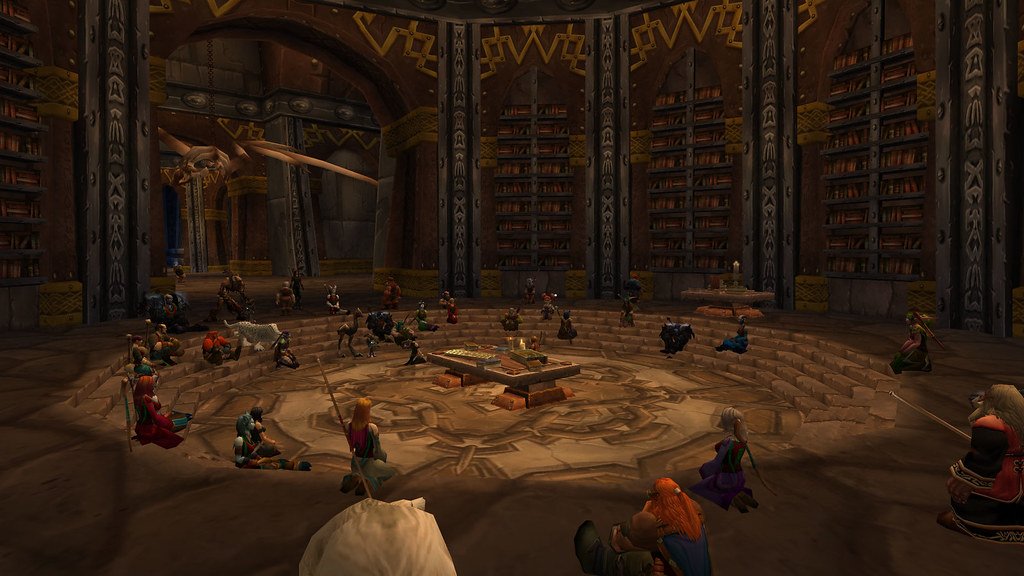
Lisa Poisso, Real-life librarians hit the Ironforge stacks (interview with Ellen Forsyth from the WoW guild Where is the Library, which runs regular discussion groups in Ironforge library)

Games and Libraries, Edited transcripts of talks (archive of the Where is the Library discussions)


Presenting

Bobbi Newman, 20 Things to Do After You Accept that Speaking Gig

R. David Lankes, Beyond the Bullet Points: Bullet Points (advice for developing speaker skills)

  
Neutrality in events and conferences

Library Camp, The Co-operative Bank Grant Application

Lauren Smith, Library Politics and Agenda-Setting


Misc.

Brian Matthews, Think Like a Startup (I haven't had time to read all of this yet, but it's good stuff. Aaron Tay's post below pulls out some of the main points)

Aaron Tay, "We're a cut-and-paste profession"

Travis McDade, The difficulty of insider book theft

In the Ironforge Library by Tourach

Monday, 21 May 2012

A couple of plugs...

CPD23
 
My 23 Things for Professional Development post Thing 4: Current Awareness is now up on the CPD23 blog, and covers Twitter, RSS and Storify. I hadn't used Storify before trying it out for this Thing, but have since used it to gather together tweets from CILIP New Professionals Day, and will definitely continue to use it.

Back from the Stacks

Newnham College Library now have a blog, Back from the Stacks. We're going to share beautiful and interesting items from our special collections, and there are a couple of posts up already about exhibitions that are up in College at the moment.

Sunday, 15 January 2012

Libraries@Cambridge Conference 2011 - the library users' perspective

I went to the afternoon session of the Libraries@Cambridge conference yesterday (and the lunch of course!) which was a thought-provoking set of short presentations by library users - academics, an undergraduate and a PhD student. Like Claire Sewell, I thought this was a brilliant idea, and wonder why this isn't done more often? Inviting library users to a library conference seems to make perfect sense.


I'd brought along my new tablet to take notes on and keep an eye on Twitter. This was the first time I'd tried taking 'proper' notes on it, and it worked very well. I was using Evernote which I fell in love with at Library Camp for how easy it made writing up my blog posts afterwards, so here's hoping this one will more or less write itself too!*


(Apologies if I've got anyone's name/job wrong, I didn't quite catch all of the introductions.)

First to speak was Anne Alexander, co-ordinator of the Digital Humanities Network. The network is funded by the University and brings together scholars from several disciplines, with a huge variety of research interests. 

The Digital Humanities Network promotes engagement between research projects and new digital tools. These tools are reconfiguring the relationship between experts and laypersons, and between users and editors. It was good to hear Anne recognising that libraries and librarians are playing a crucial role in debates about open access, the preservation of digital content, and the transformation of repositories and archives. However I was a bit disappointed not to hear a mention of user training and digital literacy, which I think a lot of libraries in Cambridge are doing rather well. 

Anne argued that the future of DH has to develop through dialogue, and that libraries will have to be at centre of this debate. The need for more dialogue between libraries and academics was a major theme of the afternoon, and Anne pointed out that before this can happen, academics and librarians may need to rethink their current impressions of each other. Anne ended by begging us not to think of her as just a library user, but as a partner and a collaborator.


Next was Mark MacGillivray, a PhD student from University of Edinburgh interested in open scholarship (he is involved in the JISC Open Bibliography project). 

Mark went to university in 1997 and saw the world wide web for the first time at the library. During his time at university he has used the library a great deal for the space to work, and for the internet, but has only borrowed a book about 4 times. He found that the best way to access information was online. Now that he is doing PhD he feels the same way but now has the internet at home so it is even easier. 

Mark argued that open access is the easiest way to do everything. If something is open access more people will know it exists. There are good reasons and bad reasons for this not happening, but a lot of effort is being put into into defining what constitutes "open" access, while all Mark wants is access.


The third speaker was Sylvia Christie, a 3rd year student at Homerton College, and I found her presentation the most useful and interesting of the afternoon. 

Thinking ahead to the future, Sylvia predicted that hardware issues will cause problems. Hardware costs money and still some students do not have laptops as they can't afford them. Kindles etc. are designed for reading for pleasure. There is no scholarly reading device. She moved onto the topic of 'Digital Natives', pointing out that most students are at the digital equivalent of "knowing how to make a cup of tea but they can't fix the kettle!" Digital literacy ironically needs face-to-face training to be fully effective. 

Sylvia emphasised the importance of having different spaces for differerent kinds of work (I believe one of the morning sessions was on the use of space in libraries). She pointed out that during her time at the conference she'd come across a lot of our somewhat strange terminology, which she was concerned may be increasing the divide between librarians and library users. Even using the word "user" is anonymising, and increasingly the person in question may be at the other end of a computer screen, increasing the sense of distance. Libraries should be about inclusion and promoting curiosity, there should not be a divide.


Then we heard from another academic, Dr Jason Scott-Warren, a lecturer in the English faculty and dirctor of the Centre for Material Texts. This is an interdisciplinary field, and includes everything from manuscripts to digital media. 

Jason started off by saying he thinks libraries in Cambridge do a terrific job (woot!). They are coming to serve as information hubs and are adjusting well to this role. Jason himself has found he is using libraries far more as a digital user. There are two side-effects of this, which I certainly can relate to: "digital greed" (just wanting more, faster, better!) and "digital anxiety" (do I know about everything I have access to?). It is a challenge for libraries to try and advertise everything they have on offer in response to digital anxiety.

Other problems exist too. There is no agreement on standards for digital stuff. Interfaces are rather clunky and painful, and Jason is often driven into the library to look at a physical text because of frustration with the online digitised version. 

However one advantage of the digitisation process seems to be that libraries are (re)discovering items in their collections, and "blowing the dust off" the items and their catalogue records. Jason requested that more copy-specific information be added to the records at this stage, owners, donors, bindings, early readers etc. Many College libraries' special collections are relatively unknown, but digitisation could allow them to be publicised more. Jason suggested that it would be good to have intellectual projects based around library collections, and integrate them with teaching. Academics, librarians and students could be working together to create materials for courses, taking down the "walls" between the different communities.


Finally we heard from Dr Rob Wallach, a Material Scientist from King's College. 

To prepare for his presentation, Rob had asked some of his students about libraries and the future. 1st and 2nd years were bewildered by the amount of choice and confused about how to access materials. They lack information literacy skills and struggle to sift through information brought back from a Google search.  This is perhaps because students are being taught very rigidly in secondary schools, to pass exams. Universities want independent learners and free thinkers, but how can we help students to make this transformation?  We need to teach students how to organise their searching and learn what is to be trusted. We need to change the way we teach, the way we expect students to use information, move assessments away from rote learning and repetition. Rob would put librarians on teaching and research committees, and encourage more discussion and partnerships, and a change of roles for everyone.

This was followed by a question from an audience member. Throughout the afternoon everyone has been in agreement that we need more discussion and librarians and academics need to work closely together, so what are the barriers to doing this? Rob repeated his earlier suggestion to get rid of library committtees, and combine into teaching and research committees. Mark added in that fear is major factor, everyone is unsure of what is the best thing to do, but we have to continue the discussions we are having.

I'm very glad that I got the chance to attend the conference for the afternoon. The session gave a lot of food for thought, and it was great to catch up with friends over lunch and over coffee afterwards. Many thanks to the Libraries@Cambridge team for doing a great job of organising the conference.


*I'm trying out putting bits in bold that I found most pertinent so that I can easily find them later. Looks a bit odd, may or may not do this again in future!

Thursday, 10 November 2011

Looking after nice old things and playing with shiny new things!

We had two guest lectures last week that between them seemed to sum up a lot of librarianship - looking after what we've got and coming up with innovative ways to introduce it all to new people.

For our Collection Management and Preservation module we had a guest lecture by Fred Bearman, UCL's Preservation Librarian, who was talking to us about the best ways to preserve our libraries' collections, and conservation of damaged materials. Fred's talk included a few horror stories of fires, floods and building collapse, but also more day-to-day dangers such as pests, dust and changes in humidity or temperature. Most of the preventative measures taken were common-sense stuff, but I picked up a few tips I hadn't heard before:
  • While cotton gloves are not recommended, if you are handling something you don't want to touch with bare hands, latex-free, powder-free gloves are another option.
  • If you're boxing materials to protect them, beware of unscrupulous people who steal the contents of the box and put the box back on the shelf.
  • Dust is abrasive and also home/food to various pests and mould spores.
  • If there are lots of spiders in your library, it means they are hunting something else which may be eating your books!
  • When putting photos etc. in Melinex sleeves, do not seal up the sleeves because... [I've forgotten why, all I have written in my notes is "DO NOT SEAL!" Anyone know why not?]
UCL Special Collections are looking out for volunteers to do some of the dusty work, I might volunteer next term when I have fewer lectures!

Friday's Digital Resources in the Humanities lecture was very different but no less interesting. We had some staff from the Petrie Museum of Egyptian Archaeology come to talk to us about digital imaging techniques, and then in the practical session we got to play around with some 3D digital versions of museum artefacts and (oh the excitement!) iPads and an augmented reality app.

In the lecture, Mona Hess and Kathryn Piquette took turns to talk about some of the techniques they have been using to create 2D and 3D images to accurately document the objects they are curating. These included close range photogrammetry, laser scanning, and even GPS for documenting buildings or larger sites. All of these techniques are non-contact and non-invasive, which is very important in conservation. Mona showed us how a broken vase could be reconstructed after being photographed systematically from lots of different angles.

As well as taking images of all the sides, it is also useful to capture the same side many times, changing the direction of the light source each time, so that all the nooks and crannies can be captured. For this, Reflectance Transformation Imaging (RTI) is used, where the object is placed inside a rather spacey looking lighting dome, and photographed with the light source moving each time. Then software such as RTIviewer allows the user to move the light around to see different parts of the object in light or in shadow.

Shiny...
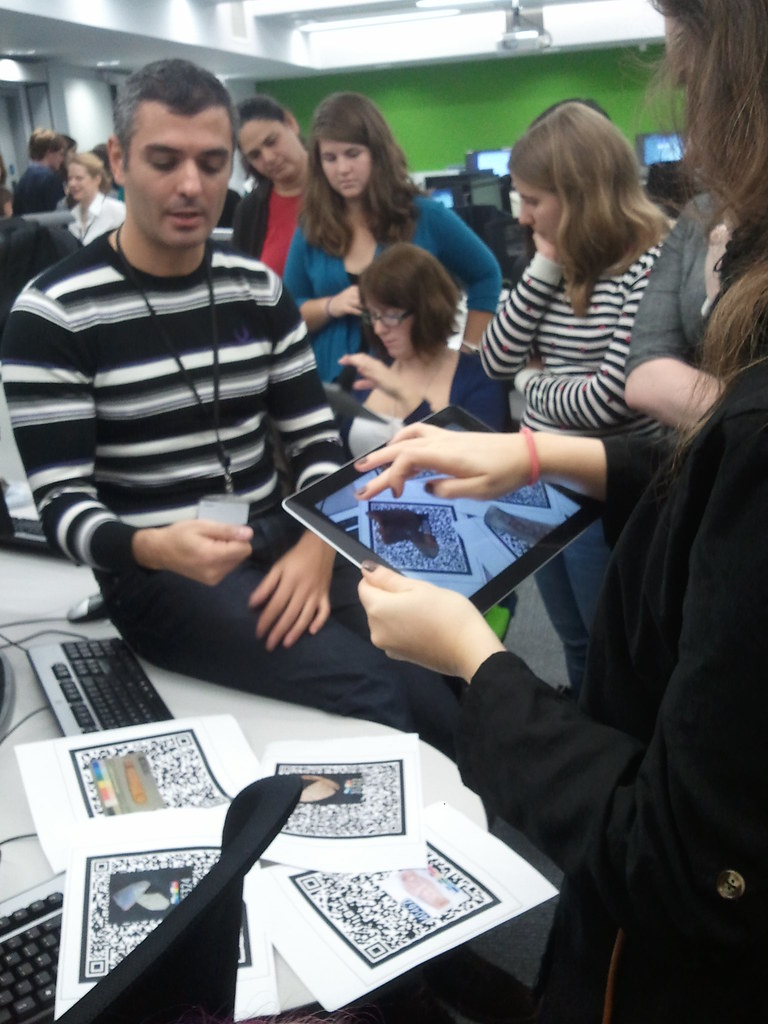
For the practical session, Giancarlo Amati arrived bearing iPads (this was what I'd been itching to get my hands on, I have serious tablet envy at the moment!) and showed us the Petrie Museum's augmented reality app. This is still a prototype, but when released will allow iPhone or iPad users to scan markers which will bring up an interactive version of the museum object. They plan to have a few iPads to loan out within the museum for those of us sans tablet.

I've seen videos of AR but hadn't tried any myself before. I was impressed by how interactive it was - I have no idea how it worked but as well as being able to turn the object by moving it with your finger on screen, you could also reach around into the empty air behind the iPad and "pick up" the sarcophagus or whatever it was you were playing with. Weird...

Obviously this is great in a museum setting as most of their collections can't be touched. When smartphones/tablets become more prolific I can imagine AR being used in a library, for instance to provide review videos when you scan a marker on a book, or to watch the trailer of a DVD. The fun thing about the Petrie Museum app though was it's interactivity, so it would be cool to work that aspect into any library AR apps. It may be a bit of a gimick, but it sure is a fun gimick!