Friday, 4 July 2014

Having my CaKE and eating it too

Books and cats, librarian cake?
Photo by AngelinaCupcake on Flickr
Earlier this week I attended the first Cambridge Knowledge Exchange event (which has the pleasing acronym of CaKE). CaKE is the brainchild of Claire Sewell and Celine Carty, who had the idea for a local forum where Cambridge librairans could share knowledge and ideas gained from conferences. There were 8 presenters at the event speaking about different conferences they had attended in the last few months. The presentations are going up on the CaKE blog, Claire's storify of tweets from the event is here, and my personal tweets are storified here.

I am fortunate that my workplace is very supportive of my professional development (I will be going to ARCLIB next week) but conferences are expensive and it is impossible to go to everything you are interested in. At this event I learnt a lot of relevant stuff from several different conferences, all in one afternoon without leaving Cambridge.

Another of the good things about this event was hearing presentations about conferences that I wouldn't have thought were that relevant to me, but turned out to be very interesting. I will keep an eye on ELAG in the future for example.

Claire Sewell giving us the low-down on MOOCs
It was particularly useful when the presenters pulled out things from the conferences that they had been able to apply in their own library. Our libraries across the University are very different in lots of ways, but we generally have similar aims and pressures, and it makes sense to share this kind of learning. I have observed a trend recently towards greater collaboration in Cambridge libraries - for example a bunch of us are working on a central FAQs page similar to Portland State's Library DIY, and at the last meeting of the Cambridge Colleges Libraries Forum we spent some time brainstorming ways that CCLF could help individual colleges more, and ways that we could work together with other groups. I'm very hopeful that this trend will continue.

I hadn't originally been planning to tweet during the event, but I ended up doing so (the hashtag was #camcake). Quite a few people were following and commenting from afar (all jealous that Claire's delicious gin cake could not be fed down the intertubes!) and it was interesting to get input from people in America and Ireland. Niamh Tumelty mentioned joint vendor & librarian sessions, with the librarians giving their honest experience of using the product. I thought this was a great idea, however Tracy Maleef from the US was surprised that this was a novel concept in the UK. Really, it makes so much sense that I don't know why it isn't done here! This is one of the reasons I like using Twitter at events and conferences - it quite often leads to interesting back-channel discussion, and opens up the conversation beyond the people physically at the event.

Some key points I noted down to follow up later were:
  • Look into Project Information Literacy and the LSE SADL project
  • Learn more about action research
  • Use the questions "what should we start doing/what should we stop doing" as an exercise
  • Look up the presentations from ELAG.
  • Keep an eye out for the Hyperlinked Library MOOC in case it runs again

Monday, 2 June 2014

First adventures in Chartership

I have taken the plunge and signed up for Chartership. Eek! Chartering has been a vague aim for a while now, something I've mentioned in job interviews when I've been asked where I see myself in X years time. But now I've paid my registration fee, found a mentor, and it is time to actually get on with it!

I had my first meeting with my mentor last week. Sheila is an information scientist managing bibliographic databases and search services for the specialist engineering firm TWI. I know that finding a mentor can be a difficult process, especially when trying to find someone in a different field from your own. I was very lucky to find a mentor quite quickly, and to find someone working in such a different role. I found my mentor through the CILIP East Mentor/Mentee Matchmaking group on Facebook which was the brainchild of Maria Giovanna, CILIP East's Candidate Support Officer.

After chatting for a while about what I wanted to get out of Chartership and going through the mentoring agreement form, Sheila gave me a tour of the library. The library at TWI provides information resources for a range of different user groups, including onsite staff, those studying for PhDs, and offsite users from many different companies. As a lot of the reports and so on in the library are confidential to some level or other, it is important to identify the user and determine whether they should be able to access the resource in question. While we have policies in the College library about who can register to borrow books, and different loan periods for different types of user, there are no restrictions on reference use - we don't have any classified information!

For offsite users, electronic copies and physical books are sent out by library staff. The online database has an 'add to cart' button for each article. Orders are sent to the library and then copies are made and sent out. The database uses a specialist thesaurus of welding-related terms. Sheila goes to an annual international conference where new terms are suggested and debated. During my Cat & Class II module at UCL I had to create my own thesaurus on a subject of my choice which I found one of the most enjoyable pieces of coursework (and not just because my subject was Harry Potter...) I haven't used that skill since my MA, so it was interesting to see this kind of work being carried out.

Cataloguing a new article for the TWI database involves a lot of work. Keywords are assigned from the thesaurus (if the topic isn't accurately covered then a free-text keyword is added - this is where Sheila looks when taking new suggestions to the annual conference). TWI information staff write their own abstracts for each article, as author-provided abstracts don't usually provide the necessary detail required by TWI employees about the types of material, techniques etc. being discussed. Journals, reports etc. are acquired from all over the world in many languages, so abstracting and keywording is a considerable task!

On my visit I saw the TWI library in its temporary home, as a new building is currently under construction. At Magdalene we are planning a new library building, so I jumped at the chance to look at site plans etc. and hear more about the process. TWI are much further along in the process than us, they will be in the new building in a matter of months whereas our new building is still several years away. When building work begins we will hopefully not have to move into temporary accomodation as, unlike at TWI, the current College Library is not being demolished to make room for the new building, but the idea is to repurpose the space afterwards and turn it into some kind of visitors centre/exhibition space for the Pepys Library.

Welded swimsuits
Before I left, Sheila showed me the exhibition space in the reception area which displays the wide range of welding techniques used, and the variety of industries supported by TWI - from communications technology to medical equipment, and even clothing. Sheila had mentioned earlier in the afternoon that some prospective mentees were put off as her role is far removed from that of e.g. an academic or public librarian, which surprised me as I found the difference in our roles fascinating.

The next steps for me are to do the PKSB gap analysis to identify which areas I'm going to focus on improving, and to spend some time playing around with the virtual learning environment on the CILIP website. My target is to complete my portfolio in a year so I better get cracking!

Monday, 24 February 2014

Academic Skills Session: Research Survival Guide

Our second session in the Academic Skills Programme was called 'Research Survival Guide: Mastering Your Dissertation or Project' (side-note, I think in hindsight that 'Surviving Your Dissertation' would have been a snappier title, but oh well...!)


As with the last session, I've adapted the content into three posts on the library blog:
I made a screencast of Zotero in action to show how the cite-while-you-write and bibliography export features work, now uploaded to YouTube with voiceover.

We also had a couple of handouts for this session - a Literature Search Plan worksheet to get the students thinking about the search terms they were going to use, and a Reference Template to take away and use to record their references if they favoured the pen-and-paper approach. The reference template was adapted from Meriel Royal's version, thank you Meriel for the idea!

Academic Skills Session: Navigating the Information Jungle

Liz Osman and I did two sessions earlier this month as part of the college's Academic Skills Programme. Our first session 'Navigating the Information Jungle' was aimed at first years, and was a kind of 'you've found your feet, where do you go from here?' session.


I've adapted the content of the session into three posts on our library blog:

Sunday, 12 January 2014

Libraries@Cambridge conference 2014

I have been to four Libraries@Cambridge conferences now, and when I compare the conference to others I've been to (thinking about Umbrella and CILIP New Professionals Conference mainly) I think Libraries@Cambridge is as good or better in lots of ways. It's free, organised in a relatively short time frame by Cambridge librarians, with most of the speakers working in Cambridge libraries, so it's usually very relevant to me. I think it's great hearing from the newest graduate trainees alongside the Bodleian's Head of Assessment and the UL's Head of Innovation.


I thought that the keynote presentation by Frankie Wilson was particularly good. A few bits that resonated with me: 
  • It's easy to change rules but harder to change the underlying culture – conscious and unconscious behaviour, values and climate.
  • Every time someone asks at the enquiry desk ‘how do I do…?’ that is feedback, and there may be something you could make more intuitive.
  • Do you pay enough attention to feedback, and do you take action? It’s easy to fall into the trap of saying that first year undergraduates for example just needs to learn ‘how it works'.
  • Are all staff (from student shelvers up) empowered to share their ideas for innovations? I consider myself lucky that I've always felt that I could share my ideas, both at Newnham and Homerton. However Frankie's mention of student shelvers has prompted me to make sure that our shelving team know that they can make suggestions.
  • "If you do the same thing every time, you’ll get the same results every time." This sparked a conversation in the Twitter backchannel with Sarah Burton, Ned Potter and Jo Alcock. We came to the conclusions that if something already works okay it probably won’t get changed, but it could potentially be better. However just because something fails once doesn’t mean it wouldn’t work another time in different circumstances.
  • Different groups/types of users will have different needs, so watch out for unintended consequences of your changes – what's better for one type of user may be worse for another.

Ben Outhwaite
Liz and I both went to the parallel session on Special Collections thinking that there may be something we could apply to Homerton's special collections (the annuals and Alice in Wonderland collection in particular for me). This session was split into three mini presentations - Ben Outhwaite from the UL's Genizah Research Unit, Suzanne Paul from the Manuscripts Department at the UL, and Camillo Formigatti and Daniele Cuneo from the Sanskrit Project, also at the UL.

Both the Genizah project and the Sanskrit project involved academics working with library staff on special collections to catalogue and digitise. Ben Outhwaite said that as well as benefitting from the academics' expertise, having academics working on special collections has led to events, funding etc. which wouldn’t otherwise have been possible. I think our special collections at Homerton have scope for collaboration with academics, something to think about more in the future.


Suzanne Paul worked with Emma Dillon from King's College London to put on a programme for Emma's students – each student was given photographs of a fragment, they then learnt palaeography, notation and so on in class, and then at the end of the term they came to the UL to see their fragment, learn about how they were stored etc. and worked on a catalogue record for the item. While this was a lot of work to put on, it benefitted both the library and the students. 

After the lunch my second parallel session was 'Quality for Who?' by Paul-Jervis Heath. I had volunteered to live-blog this session for the conference blog, so you can read the whole thing there.

The project that Paul and his design team have been working on has been to study students and academics and come up with 'personas' or sets of motivations and behaviours which are present in everyone at different levels. For example these are the three student personas in brief (there is a lot more detail in this PDF)
  • David is at Cambridge in order to get a job at a top firm. He's kind of interested in his subject, but targets what he does in order to build a network and find a job later. He 'hacks' the system by dividing the reading lists with his friends, and they then swap notes on the books they have read. 
  • Mattias is here to enjoy the things that university has to offer. He wants to do well, but he wants to make friends and have fun. 
  • Katrina is reading every single book on her reading list and is really feeling the pressure. She isn't sure she's on the right track, and is working well into the night and all weekend.
Paul students like David are setting things up on their own such as Facebook groups to share notes on books. Would it help if librarians were to set up an official version of this? Perhaps then students like Katrina would be helped because they wouldn't feel like sharing was cutting corners. However I was wondering as Paul said this whether or not we should be trying so hard to make things easier for students? I'm not saying that we need to set an artificial difficulty level, but it would feel a bit wrong to me if the library was encouraging students not to go through their reading list thoroughly! I'd be interested in what other people think about this though as I do recognise 'Katrina' in quite a few of our students. We have been coming up with ways at Homerton to encourage students to take regular breaks, and we occasionally liaise with personal tutors if it appears a student is struggling or putting a lot of pressure on themselves.

I was interested by Paul's explanation of Kano categories for service features, which I had not heard of before.

Graduate trainees' presentation
The final session was made up of lots of mini presentations by speakers from across the University including this year's graduate trainees, Isla Kuhn from the Medical School Library, Georgina Cronin from SPRI, and the team from Christ's College (Lucy Woolhouse is the graduate trainee at Christ's, so she was working extra hard during this session!)

As always, a lot of the valuable stuff at a conference comes over pastries at break time or over a glass of wine at the end! I had a good catch up with some friends, and met a couple of lovely new people, including on the bus ride back to the station!


Friday, 10 January 2014

Blowing away the cobwebs

I know this kind of post is such a cliche at this time of year, but a combination of the New Year and the Libraries@Cambridge conference have reminded me that I've neglected my blog for far too long!

My last post was over a year ago, and so much has happened since then. Rory and I bought a house earlier in the year and we got married in October (see photographic evidence below). We also now have guinea pigs! Basically we did All The Things in one year and now will relax for the next 5 years :D


Work has also been pretty exciting. Over the summer I was involved in hiring a new member of staff, including being part of the interview panel. The Children's Literature Collection that I manage is growing very quickly, as we've acquired a donation of 150+ versions of Lewis Carroll's Alice in Wonderland, and a very large donation of 7,000ish children's annuals (which promptly went into storage and will stay there until we work out where they are going to go!) Liz and I are going to be presenting two academic skills sessions in February, so I'm putting that together now. I'll hopefully blog about some of these things at some point, especially about being on an interview panel, as that was a fascinating experience.

I was lucky enough last year to get a bursary from CILIP East which enabled me to get to my first Umbrella conference, and I also went to two regional library camps. At the Libraries@Cambridge conference yesterday I live-blogged Paul-Jervis Heath's session 'Quality for Who?' on the Libraries@Cambridge blog, but I've got a bunch of other notes and I'm going to blog some of my thoughts on the rest of the conference later this week.


Sunday, 4 November 2012

What I've been reading in October

Social Media

Phil Bradley, Should we outlaw 'social media'?

Phil Bradley, Personal reputation in a social media world

Literacy

Lane Wilkinson, Beyond 'Beyond Literacy'

School Libraries

The Guardian, Library campaigners to meet MPs

Chartership

Jo Alcock, Joeyanne McLip (one to come back to when I decide to attempt chartership!)

Events and Networking

Stephanie Taylor, #uklibchat in RL! (summary of the #uklibchat session at Library Camp 2012)

#uklibchat, Summary - 10th July 2012 - Conferences, events and networking

Publishing

Publishers Weekly, Random House, Penguin Agree to Merge

Monday, 15 October 2012

#uklibchat at Library Camp 2012

On Saturday I went to my second Library Camp, an unconference event held in Birmingham. While I enjoyed the whole day (and will hopefully blog about it at some point this week), the highlight for me was the I helped to facilitate with other members of the uklibchat team on the topic of careers.

 After a delayed train and a half-an-hour scurry across Birmingham (I have short legs and was walking with some tall people!) I arrived at the venue in the middle of the session proposals. Luckily, Linsey and Lyle were on hand to propose the uklibchat session while I got my breath back. A post-it with our session name got stuck up on the timetable, and we were in!

Photo by Sarah Childs
We'd picked careers as it had been the most popular topic for uklibchat this year, and we hoped it would be something that plenty of people would want to talk about. Lots of people did turn up, and we had a good discussion which I was very happy about!

All the tweets are archived on Storify, and there is a post on the uklibchat blog which gathers together resources mentioned during the session, and posts from other blogs about the session.

Things that didn't go as planned:
  • Wifi. The venue's wifi was either broken or just not equipped to handle so many tweeting and blogging librarians! I wasn't able to get a connection at all, so our grand plans of a hybrid session had to be scaled back a bit. We'd been hoping to live tweet the session, take questions from Twitter as well as the room, and set up a projector with a #uklibchat twitter stream so everyone could see all the tweets. However I was able to tweet from my phone, and we did have several people participating remotely. We'll have to try again at another event in the future!
  • Sadly Ka-Ming missed her train and couldn't make it to Birmingham which was such a shame, but I thought Sarah and Linsey did a great job of introducing and facilitating the session without her. I was just desperately trying to keep up with the tweets as I'm pretty slow at typing on my phone!
Things which worked well:
  • There was a really good mix of sectors and experience among the people at the session, which was great for this topic.
  • People who couldn't make it to the session at the time were chipping in with their opinions on chartership, recruitment agencies etc. for the rest of the day on the #uklibchat hashtag.
  • In the first session of the morning a few people had pointed out that it was difficult to follow the different sessions simultaneously being tweeted about on the #libcampuk12 hashtag, so I decided to stick to the #uklibchat hashtag for our session (having tweeted a couple of times on #libcampuk12 to warn people that that's what I was doing). I think this made it much easier to follow the session as we were going along, and to archive it afterwards.
  • Lots of people took business cards at the end, woohoo!
Hopefully everyone who came to the session took something away from it. I found it an interesting discussion at least!

Photo by Sarah Childs

Tuesday, 25 September 2012

Visiting Cambridge University Library Map Room

Last week I visited the Map Room at the UL for Cambridge Library Group's first meeting of the year. Although I've spent a fair amount of time at the UL over the last couple of years, I'd not been to the Map Room before, and was really impressed by the gorgeous items on display.

Anne Taylor and Andrew Alexander introduced us to the collection, which includes originals and facsimiles of manuscript and early printed maps and atlases, as well as modern maps, and a large collection of postcards. While a lot comes to the department through legal deposit, they also buy antiquarian and modern maps, and receive donations (in particular from the Ministry of Defence's map library, the largest map library in the country, which purchases four copies of every map and then donates three of the copies to libraries around the country when they purchase a new edition). When the Ordnance Survey maps went online and the OS archives decided not to keep their 1st edition maps, the UL purchased that collection, which showed up in three lorries rather unexpectedly one day!

Anne and Andrew had put a variety of maps out on display for our group, including a beautifully illustrated celestial atlas by Andreas Cellarias from 1661, a colourful world map titled TEA REVIVES THE WORLD! produced by the International Tea Market Expansion Board which was covered in quotes and facts about tea, and OS snapshots of the Olympic Park site taken at various points since we won the bid, showing the development there. My favourite was a map of Iceland drawn by Abraham Ortelius in around 1595, showing sea monsters surrounding the island complete with notes in Latin describing each beast (e.g. "All gristly, rather like a skate, but infinitely larger"). There's an image of part of that map on the map department's website here.

It was a great visit, and I ended up being one of the last hangers-on who spent so long looking at the maps that Andrew threatened to put us to work cataloguing them! Having had a taste of the confusing world of scales, projections and co-ordinates in my Cat & Class module at UCL I didn't take Andrew up on his offer, but will definitely visit again!

Tuesday, 4 September 2012

What I've been reading in August

Well, we did it! My MA class has now submitted our dissertations, and that's the end of my year at UCL. This blog has been very quiet over the summer for obvious reasons, but I'm hoping to get back into the habit of blogging regularly once more now that I have a bit more time on my hands!  I managed to keep the monthly round up posts going though as they're fairly quick to put together, and here is what I've been reading in August (or in most cases this month, what I kept unread until the start of September!)

eBooks

Andy Woodworth, Libraries and eBook Publishers: Friend Zone Level 300


Marketing library services

Naomi Tiley, IFLA Conference: Marketing of Rare and Special Collections in a Digital Age

Stpehen Barr, How should academic libraries communicate their own value? 


Information Literacy

Daniel Russell, Internet Search: What makes it simple, difficult or impossible?

Meredith Farkas, The devil you know in first-year instruction


Games and libraries

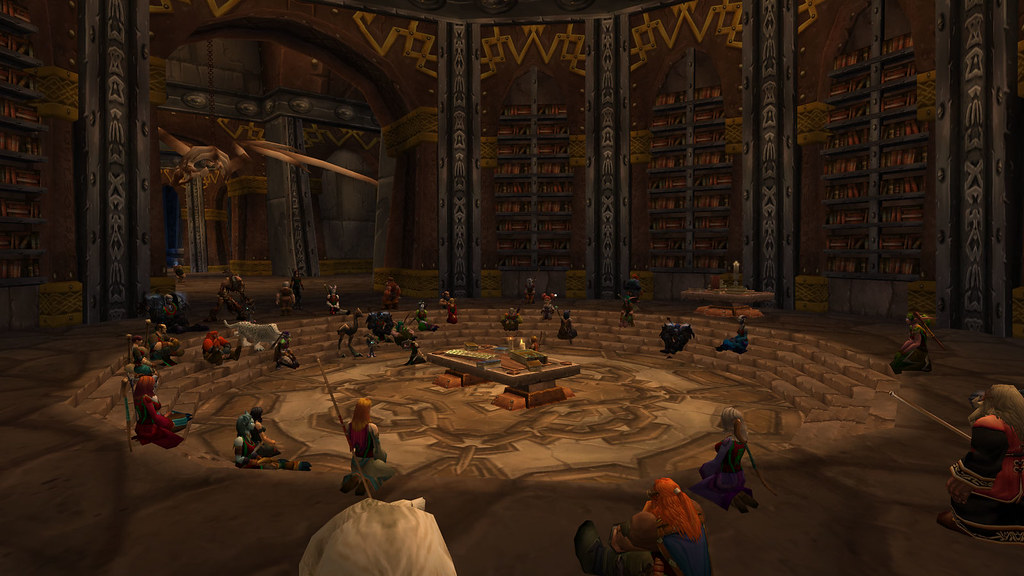
Lisa Poisso, Real-life librarians hit the Ironforge stacks (interview with Ellen Forsyth from the WoW guild Where is the Library, which runs regular discussion groups in Ironforge library)

Games and Libraries, Edited transcripts of talks (archive of the Where is the Library discussions)


Presenting

Bobbi Newman, 20 Things to Do After You Accept that Speaking Gig

R. David Lankes, Beyond the Bullet Points: Bullet Points (advice for developing speaker skills)

  
Neutrality in events and conferences

Library Camp, The Co-operative Bank Grant Application

Lauren Smith, Library Politics and Agenda-Setting


Misc.

Brian Matthews, Think Like a Startup (I haven't had time to read all of this yet, but it's good stuff. Aaron Tay's post below pulls out some of the main points)

Aaron Tay, "We're a cut-and-paste profession"

Travis McDade, The difficulty of insider book theft

In the Ironforge Library by Tourach

Sunday, 29 July 2012

What I've been reading in July

Mashcat

I found Mashcat a really interesting unconference. I won't pretend to have understood everything that was talked about, but I definitely learnt a lot! These are the slides/blog posts from my favourite sessions.

Ed Chamberlain, Text to data [slides]

Gary Green, A Travellers Map in Yahoo Pipes (Really cool visual way to search subject headings referring to places)

Owen Stephens, Boutique Catalogues (Includes demonstration of how a catalogue could be customised for musicians, creating faceted indexes for key, bpm and time-signature)


Presenting

Ned Potter, Good presentations matter


Libraries and the Internet

Lauren Smith, Internet Access and Public Libraries

Phil Bradley, Libraries charging for internet access is wrong

Voices for the Library, Free internet access should be a cornerstone of every public library

Ian Clark, Barking libraries - tiny cuts or massive scars?

CILIP, Act risks limiting internet access in libraries, schools and universities


E-books

Alison Flood, Call to 'move libraries into 21st century' sparks ebook lending review


Volunteer libraries

CILIP, Value of staff at heart of revised volunteer policy

Dalya Alberge, Authors face royalty threat from volunteer libraries

Ian Anstice, Surrey chooses volunteers over paid staff at the same cost


Online learning

Emma Cragg, Where next for 23 Things?   (I've heard a lot about coursera lately, and I'm definitely going to look into it when I finish my MA. One course at a time though...)

By Guillermo Esteves on Flickr

Thursday, 12 July 2012

#CPD23 Thing 10, revisited

A year ago when I wrote about Thing 10, I had almost finished my graduate traineeship, and had a place at UCL on the MA Library and Information Studies course. A year later of course, the end of my MA (read: dissertation deadline!) is rushing closer and closer, and I'm thinking about what I'll be doing after this is over.

On the whole I've really enjoyed my MA, I feel that I've learnt a lot, and the variety of assessments have given me experience that would have been difficult to get at work (such as writing a collection management policy, and coming up with a budget and staff structure for a library in the Management module). I was lucky enough to get a bursary for this year, but before I found out I'd got that I'd been prepared to fork out for the £5000-odd fees. It's a lot of money, but with an MA under my belt I can apply for professional roles with a bit of a pay-rise and it'll hopefully pay for itself within a few years.


I think if I hadn't got a bursary I would have still felt I got my money's worth at £5k, but as Jen shows with her pretty pink spreadsheet, next year UCL's fees will be up to £7750 for the full-time course, and City is going to be charging a whopping £9000 (there are still some relatively affordable full-time courses, such as MMU which is £4000, but in a few years I imagine they'll all be raising the fees). As Jen says, this puts the traditional masters firmly out of reach for an awful lot of people. Distance learning courses are cheaper, but aren't for everyone (I don't think that style of learning would have suited me well, I like lectures and seminars and working with other people). I really hope we don't get into a situation where there is a divide in the profession between those who can afford the qualification and those who can't, but I'm worried that this could well happen.

Doom and gloom post, sorry. :(


Wednesday, 4 July 2012

#CPD23 Thing 9 revisited

As a Christmas present to myself I bought a Samsung Galaxy tablet when it was on sale in January. It was definitely something I wanted rather than needed, and I spent weeks debating whether to splurge that much money on something I didn't actually need. However I've been using it for all the time, for emails, Twitter, Facebook, reading e-books, taking notes in lectures, playing games... etc. etc. I still love my laptop, but it's pretty big and heavy which makes it a bit of a mission taking it out and about, so it's great to have a portable alternative.
Evernote interface

I've found that some of the tools I discovered in 23 Things but didn't get that excited about, have suddenly become much more useful now I'm using the tablet, in particular Evernote. The interface on the mobile version is so much nicer than the rather dull PC version (see right), and it's very intuitive. I'm using it for my lecture notes and quotations I want to put in essays, nothing too fancy, but it's working very well. I could have used Google Docs for the same thing, but I find editting Google Docs quite fiddly on the tablet, even in the app version.

I think I still haven't taken full advantage of Evernote yet, as it has all kinds of things like OCR for images and handwriting, and I discovered entirely by accident in my last lecture that it has a recording feature, and my tablet has a microphone, so I could have recorded all of my lectures as well as taking notes. So when I get a chance I really need to sit down and explore all of the features I don't use, because some of them are probably very useful!

Sunday, 1 July 2012

What I've been reading in June

Save Libraries

Ruthie Saylor, The night they came to arrest the library

Rita Meade, Where Would You Be Without Your Library? (Brought a tear to my eye!) 

Anita Pati, Country dancing and learning support: the new face of the council library

Alison Flood, Ed Vaizey says libraries 'thriving' and rejects prediction of 600 closures

Ian Anstice, Special report: Ed Vaizey's most important speech since he took office

Ebooks

OnlineUniversities blog, 10 Reasons Why Students Aren't Using eTextbooks

Pew Internet, Libraries, Patrons and E-books: Libraries in Transition

Bobbi Newman, The Good, The Bad, and The Ugly (and the Interesting) of Libraries and eBooks - Pew's Latest Report

Leadership

#uklibchat, Libraries and Leadership [Storify]

Nicola Franklin, Some thoughts on leadership and management 

Simon Barron, We're all leaders now 

Library design, space management etc.

#uklibchat, Library Spaces and Space Management 12th June 2012 [Storify]

Jonathan Shaw, The Library Test Kitchen

Information Literacy

#uklibchat, Summary - 26th June: Information Literacy & Needs

Steve Wheeler, Blogging as literacy 

John Tedesco, How to solve impossible problems: Daniel Russell's awesome Google search techniques

Meredith Farkas, Broad vs. deep in information literacy instruction 

Conferences

Ian Clark, Lighting the Future - a personal perspective ("I say you should grumble and grumble loudly.  And not just grumble, actually try to do something about it.")

John Kirriemuir, Don't shush me, I'm tweeting the speaker

Dissertation

Leo Casey, How to Write a Literature Review for a Dissertation 

Literature Review HQ, 3 Great Methods to Structure Your Literature Review

Reading by Rachel Sian on Flickr

Friday, 15 June 2012

#CPD23 Thing 7, revisited

I'd hoped to be able to go to the CPD23 networking event in Cambridge yesterday, but unfortunately Rory needed our car in the evening, so I'll have to settle for writing about Thing 7 instead!

I've not blogged about any of the Things so far this year, as I'm still using them in pretty much the same way as before. However since last year's post on face-to-face networking, I've made a real effort to do more offline networking. Taking advantage of the fact that I've been in London a lot this year, I've been to a couple of LISNPN meetups with lovely London graduate trainees, met up with several people I know from Twitter, and I've started going fairly regularly to London Information and Knowledge Exchange events which has been a great way to meet information professionals from other sectors.

I said last year that I thought joining a committee might be something I'd try at some point in the future, well with some encouragement from Chris, I joined the Cambridge Library Group committee in September, which has been a really worthwhile experience so far. In a few weeks there's the CLG garden party at Newnham, which will be the first event I've organised for the group. I've got my fingers and toes crossed that all goes well and it doesn't rain!

Like many librarians, I'm somewhat of an introvert, and find "networking breaks" with rooms full of people I don't know to be a scary prospect.  But the lovely thing is, the more events you go to, and the more people you meet, the more those rooms become filled with friends rather than scary strangers.

If you're a fairly new librarian and like me are a bit nervous of networking, I'd really recommend LISNPN meetups if you see one going on in your area. They're very informal, usually in a pub, and I've met some really nice people through LISNPN. Getting to know people online before you meet them face-to-face helps tremendously too. So, if anyone fancies another LISNPN meetup in London at some point soon, let me know!

Tweeters getting out and about. Image by tanakawho on Flickr

Friday, 1 June 2012

What I've been reading in May

CILIP New Professionals Day 2012

Speaker and workshop presentations

Ned Potter, You already have a brand! Here are 5 ways to influence it (#CILIPNPD12) (contains links to blog posts about the day)

Social Media

Simon Barron, "Pictures or it didn't happen." (Reflections on the negative impact of Twitter)

Andy Burkhardt, Puppies in the library and social media (Puppies! No more needs to be said.)

Google

Lance Ulanoff, Google Search Just Got 1,000 Times Smarter 

Volunteers in libraries

Helen Murphy, 50 shades of volunteering (also known as #CPD23 Thing 22: Volunteering)

Voices for the Library, Arts Chief Executive comments on need for skilled library staff

Chartered Institute of Library and Information Professionals, CILIP's Policy on the Use of Volunteers in Public Libraries: A Review

Ian Anstice, CILIP Policy on Volunteers not explicitly against direct substitution of staff

Gary Green, CILIP Volunteer Policy & Job Substitution: Letter to CILIP Update 

Johanna Anderson, CILIP and "job substitution" 

Phil Bradley, Volunteers in Public Libraries

Lisa Hutchins, Volunteers: What organisations say and what they do

Ian Anstice, Grey is not a popular colour 

Library Masters

Jen Laurenson, Masters schmasters? Rising fees, methods of learning and general confusion

eBooks

Samantha Murphy, Harry Potter Series Coming to Kindle Library in June

Lindsay Barber, Alternative E-Book Lending Models Gaining Ground and Harry Potter Meets Amazon's Lending Library

Anna Baddely, Writers won't lose out if libraries lend ebooks

Alison Flood, Pay us for library ebook loans, say authors

Misc.

Funktious, In which I rant about 24 Hour Opening... 

Ned Potter, 6 useful things Prezi can do (which even experienced users miss)

Library by Ellen Forsyth on Flickr
 

Monday, 21 May 2012

A couple of plugs...

CPD23
 
My 23 Things for Professional Development post Thing 4: Current Awareness is now up on the CPD23 blog, and covers Twitter, RSS and Storify. I hadn't used Storify before trying it out for this Thing, but have since used it to gather together tweets from CILIP New Professionals Day, and will definitely continue to use it.

Back from the Stacks

Newnham College Library now have a blog, Back from the Stacks. We're going to share beautiful and interesting items from our special collections, and there are a couple of posts up already about exhibitions that are up in College at the moment.

Saturday, 12 May 2012

#CILIPnpd12 - Phil Bradley

Here's my final Storify of the day, on Phil Bradley's keynote speech and the panel Q&A. It's also available on the Storify website here, and all of the presentations from the whole day should go up on the CILIP New Professionals Day website soon.